Showing posts with label bpm. Show all posts

Monday, February 04, 2008

Let's Get Real Guys ...

I came across this article in SOA World today:

Bridging the Gap between Business & IT with BPMN & BPEL
— Because the role of IT organizations is to enable business managers to run their businesses better, there has been a constant need for aligning IT closer to business. We often hear business managers complain that a software solution isn't what the business needed. We have personal experience with this problem - in a previous life one of us worked for a consulting company that built turnkey applications for large enterprises.

It basically talks about the approach and tooling from Oracle to allow business users and IT to jointly create business process models to, as the title says "bridge the gap between business and IT". While I have no major objections to the approach they're describing in the article--I think it's actually a pretty good solution to address the standards divide, i.e. BPMN vs. BPEL, in the business process space, I do object to how they envision this being used. They describe essentially a process where a business user uses the graphical BPMN-based modeling tool to design the business process and IT takes this as a blueprint to create the BPEL-based executable process.

I don't know what kind of business users they have come across (or are envisioning), but I've never met any business user who's able or willing to use any type of modeling tool to layout their business process for you. They're too busy actually trying to run the business. The best you can expect to get from them is some type of document that roughly describes the process and it's up to us IT shmucks to try create some type of process model out of that.

Oracle has one of the better suites for BPM out there since their acquisition of Collaxa several years ago, but let's get real guys, it's not the business users that are using that, no matter how graphical and friendly the tool is--it's still us IT guys that are the ones solely using that stuff. These guys need to know who their customers are and how they're using the product and not make up some nirvana-like scenario of business users modeling their business process and IT taking that to create the executable for alignment between the business and IT.



Bookmark and Share

Saturday, October 07, 2006

Business Process Patterns

In my work with various clients, I'm starting to take note of the common scenarios I'm seeing of how people are using SOA to improve their business processes. I'm sure others are starting to notice some recurring scenarios as well. By capturing these scenarios, we can develop a set of patterns that can be used to address them. What sets these apart from the other types of patterns we see in software such as design patterns or implementation patterns are that these are analysis patterns. Years ago, Martin Fowler wrote a book called Analysis Patterns which I still find to be a very useful book today. The patterns in that book however are finer-grained and more domain specific. What I am referring to are a broader set of analysis patterns that help you to analyze and decompose complex business processes which can be applied to any domain. The relevance to SOA of course is that business process analysis is one of the critical initial steps to any SOA initiative. Having such a set of common process analysis patterns will help to create a much more definitive SOA methodology which I think we are still lacking.

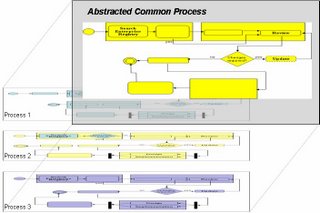
Here's one example of a recurring scenario that I see: Multiple Variant Processes to Perform a Common Function. In a large organization with multiple subsidiaries, there are often common functions that each of those subsidiaries perform but with their own slightly unique processes for doing so. For example, a lot of large organizations have subsidiaries that have their own unique processes for procurement. Often times the parent organization will want to integrate with the processes of the subsidiaries or it will want to integrate the subsidiaries’ processes together. So how do you go about analyzing all the subsidiaries’ processes to figure what/where to integrate? This can be pretty overwhelming if there are a lot of subsidiaries and the processes are complex.

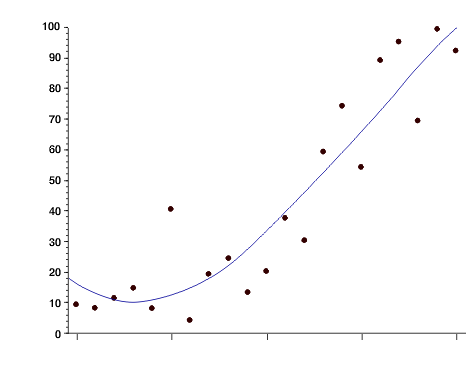
An effective way to analyze the variant processes is to abstract a common process out of them. This is analogous to extracting a trend line from a scatter plot graph. In a scatter plot, trying to look at the individual points to understand and draw relationships out of the data is very difficult, thus, you generate a common trend line out of those points.

With process analysis, it is very easy to get caught up in all the details of the individual processes and lose sight of the relationships across the processes that are important for integration. Thus, you should abstract a common process out of the individual processes and use that common process to direct your analysis of the individual processes.

, ,

Thursday, July 06, 2006

BAM and SOA

Saw some talk (from David Linthicum and David Black) recently in the blogosphere on doing business activity monitoring (BAM) and business intelligence (BI) within SOAs. This is an idea I've been keen on for a while now. Wrote an article about it for DM Review last August.

The opportunity lays in the fact that SOAs have a holistic view of the business processes that are executing within them, thus they can provide the context that ties together the data collected from BAM or BI to provide actionable information at a business level versus just giving you the raw data that your analysts have to try to manually tie together. Combine this with the fact that you have standard XML messages from which to harvest the data from and it becomes a very attractive opportunity that organizations with SOAs should definitely take advantage of.

In his entry, Black goes a bit further to talk about how ESBs can provide a good platform for this stuff, which is essentially what I was detailing in my article as well. According to his blog, Black, who recently joined Cape Clear, will be working to help them add BAM capabilities to their ESB. This will be a great feature that will distinguish them from their competitors. I'll definitely be keeping my eye out for this feature to see when it becomes available.

, , ,